-
Trivia # 1

The inside and outside, and top and bottom of a mask. If you wear it incorrectly, you'll end up inhaling pollen!
-


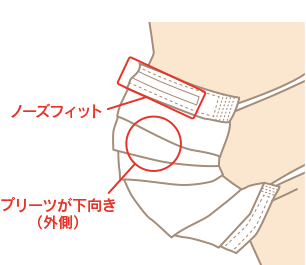
You can check the "nose fit" and the direction of the pleats!
First, the side with the wire-like "nose fit" embedded to ensure a tight seal between the mask and your nose should be facing upwards. Furthermore, with the nose fit facing upwards, the side with the pleats pointing downwards is the outer surface.
Please be careful not to wear a mask with the pleats facing upwards, as pollen can accumulate in the pleats and you may inhale it the moment you take it off.
*The above is a general description of pleated masks. Please check the correct usage instructions and wear the mask properly.
-
Trivia # 2

Some people can alleviate their symptoms during peak season by taking early precautions against pollen!
-

It has the effect of alleviating painful symptoms!
Taking measures against hay fever before symptoms appear, or even early in the season when symptoms are mild, can help alleviate symptoms during the peak pollen season.
Start taking precautions about one to two weeks in advance!
-
Trivia # 3
Even if you flee back to your home, your room is actually full of pollen!
-
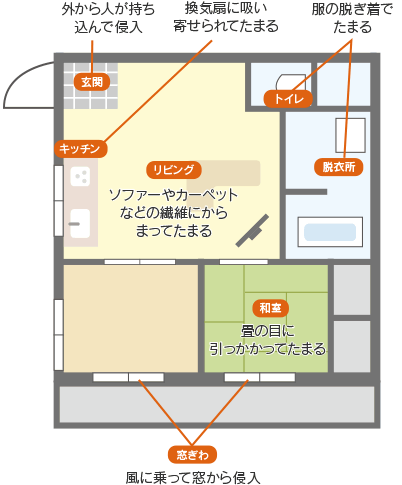
The main place they're located is the entrance. But actually, they're accumulating in all sorts of places.
The most common route for pollen to enter a room is, of course, the front door. Pollen can get in on your clothes and other items when you go in and out, so take precautions to prevent it from entering by brushing off any pollen or using an anti-static spray before entering the room.
Other areas to watch out for include near windows and ventilation fans, as well as carpets, rugs, and tatami mats where pollen easily gets trapped. Frequent cleaning is important.
Wearing a mask while cleaning can significantly reduce the amount of air you inhale, so it's quite effective.
-
Trivia # 4

Pollen is released into the air at midday and falls in the evening!
-
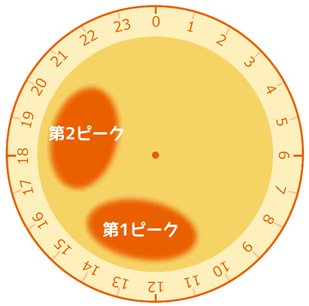
It is said that the most common times are around lunchtime and in the evening.
The time of day when cedar pollen levels are highest varies depending on the weather conditions, season, and area, but data generally shows that levels are highest around midday and around sunset. As temperatures rise, pollen released from cedar forests in the morning reaches urban areas a few hours later, so the peak occurs around midday.
Furthermore, it appears that the second peak will occur around evening when pollen that has been floating in the air falls to the ground.
For business people, the time they return home from work is more of a concern than their commuting time. Using masks and pollen-blocking glasses is also recommended.
-
Trivia # 5

Dogs and cats also feel depressed during pollen season!
-

Dogs and cats can get hay fever too!
Hay fever symptoms develop when antibodies are produced in the body, so pets such as dogs and cats can also get hay fever. Like humans, they may experience symptoms such as sneezing, runny nose, and itchy eyes, or they may experience itchy skin.
If you experience symptoms depending on the season, you might have hay fever!
Incidentally, organisms that do not have antibodies, such as insects, do not develop hay fever.
-
Trivia # 6

Actually, is the eldest son more prone to hay fever than the second son?
-
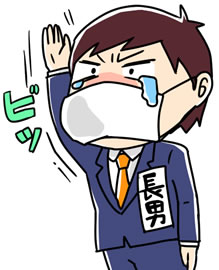
Is the strength to fight against hay fever cultivated during childhood?
Our survey revealed that approximately 40% of firstborns suffer from hay fever. In contrast, this figure was less than 30% for second and third children. This result is close to the "hygiene hypothesis," which suggests that as siblings increase, younger children become less prone to allergies because they contract infections from older siblings and thus develop stronger immune systems.
Furthermore, only 10% of people with hay fever said they were outdoorsy and used to go to various places.
There is data suggesting that children who grow up getting plenty of sunlight are less likely to develop hay fever or eczema at a young age. Perhaps being accustomed to the outdoors from a young age makes you less susceptible to hay fever?!
In recent years, there has been a trend of children experiencing pollen allergies and developing hay fever at younger ages. However, rather than being overly protective and creating a special environment, perhaps not worrying too much might actually help children develop a stronger resistance to pollen.
*Based on the results of a survey conducted on November 28, 2014, involving 500 people suffering from hay fever.
-
Trivia # 7

Even if you live in a 200-story apartment building, pollen still gets in!
-
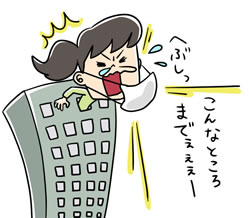
It is said to fly to an altitude of over 600 meters.
Pollen is light and easily gets airborne, so don't assume you're safe just because you live on an upper floor of an apartment building!
For reference, a typical 10-story apartment building is about 30 meters high. 600 meters would be equivalent to 200 floors! The Tokyo Skytree is 634 meters tall. Pollen is truly formidable!