Children's hay fever cases are on the rise!!
In December 2014, Rohto Pharmaceutical conducted a survey on "Children's Hay Fever" targeting parents of children aged 0-16, with the aim of raising awareness about measures against hay fever. We compiled and analyzed the symptoms and actual conditions of the 1,522 parents and 2,452 children who responded to the survey.
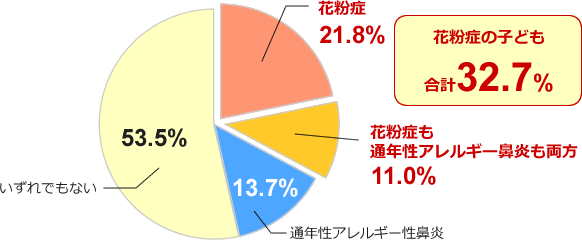
One in three children suffers from hay fever.
Among 2,452 children of 1,522 parents aged 0-16, 32.7% of the children were perceived by their parents as having hay fever (including both hay fever and perennial allergic rhinitis). This means that roughly one in three children is perceived as having hay fever. Furthermore, nearly half of the children were experiencing either perennial allergic rhinitis or hay fever.
 Survey results
Question: Do you think your child has hay fever?
N=2,452
Hay fever is the most common allergic symptom in children.
When asked about the symptoms their children currently experience, 32.7% cited "hay fever," compared to only 10.6% for "atopic dermatitis." The percentage of children with hay fever was more than three times higher than the percentage of children with atopic dermatitis.
Survey results
Question: Do you think your child has hay fever?
N=2,452
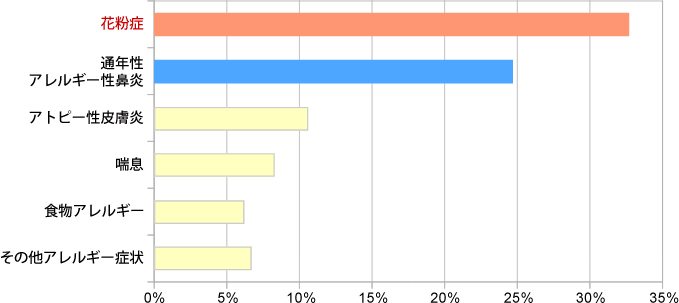
*This is based on the parents' personal experience and not a doctor's diagnosis.
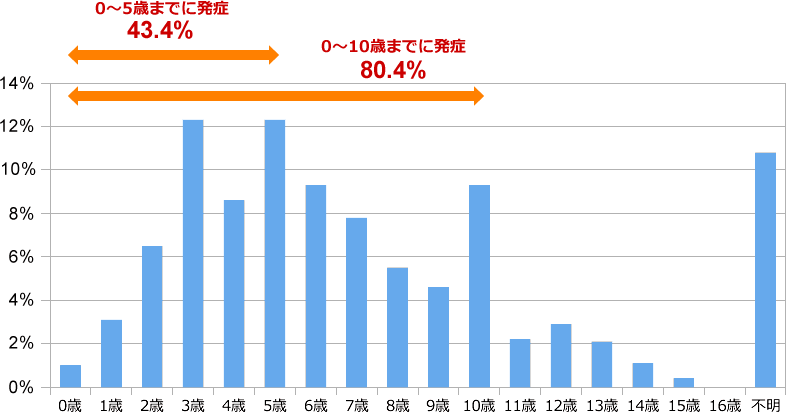
Hay fever is becoming more common in younger children. Over 40% of cases occur by age 5.
When parents whose children have experienced hay fever were asked about the age at which the symptoms began, the most common answers were "3 years old" and "5 years old," accounting for 12.3%. 43.8% experienced symptoms between the ages of 0 and 5, and 80.4% between the ages of 0 and 10.
Survey results
Question: At what age do you think your child developed hay fever? (Only answer if you answered "I think my child has hay fever.")
N=803
Survey Design
| Research Method | Online survey |
|---|
| Research Objectives | By raising awareness about the realities of childhood hay fever, we can help in raising awareness about hay fever prevention measures. |
|---|
| Research and analysis | Rohto Pharmaceutical Co., Ltd. |
|---|
| Target area | Nationwide |
|---|
| Survey period | December 2nd - December 8th, 2014 |
|---|
| Survey subjects | Parents of children aged 0 to 16
*The survey results are based on the experiences of the responding parents and are not numerical data from medical examinations. *Responses were collected according to the number of children. |
|---|
| Sample size | 1,522 people |
|---|
Past surveys have yielded some surprising results!!
In December 2012, Rohto Pharmaceutical conducted a survey on "Children's Hay Fever" targeting parents of children aged 0-16, with the aim of raising awareness about measures against hay fever. We compiled and analyzed the symptoms and actual conditions of the 2,587 parents and 4,371 children who responded to the survey.
If both parents suffer from hay fever, more than 40% of their children will also suffer from hay fever.
In the same survey conducted in 2012 (*1), parents were asked whether they suffered from hay fever, and the correlation between this and whether their children developed hay fever was examined. The results showed that 43.2% of children whose parents both suffered from hay fever had hay fever, compared to only 11.6% of children whose parents neither suffered from hay fever.
Furthermore, the survey revealed that 23.4% of children whose fathers alone suffer from hay fever develop the condition, while 32.8% of children whose mothers alone suffer from hay fever develop the condition.
*1) Conducted in December 2012. Results of a survey of 2,587 parents with children aged 0-16 and 4,371 of their children (conducted by Rohto Pharmaceutical Co., Ltd.)
Firstborn children tend to be more prone to hay fever.
In the same survey conducted in 2012 (*1), when we asked children aged 10-16 (*2) about their birth order and the onset of hay fever, 39.7% of firstborns, 29.2% of secondborns, and 28.6% of thirdborns reported having hay fever.
The results were close to the "hygiene hypothesis," which suggests that the first child is most likely to develop allergies, and that as the number of siblings increases (second child, third child, etc.), children become stronger due to infectious diseases transmitted from older siblings and are less likely to develop allergies.
*1) Conducted in December 2012. Results of a survey of 2,587 parents with children aged 0-16 and 4,371 of their children (conducted by Rohto Pharmaceutical Co., Ltd.) *2) Since the number of firstborns is likely to be higher for children under 10 due to age, the data was compiled only for children aged 10 and over.
From a pollen allergy specialist
Based on the results of this survey, we received opinions and advice from a specialist in pediatric allergies.

Dr. Yutaka Suehiro
Osaka Saiseikai Nakatsu Hospital, Department of Pediatrics, Immunology and Allergy Center
Councilor and Director of the Japanese Society for Pediatric Allergy
The age at which people suffer from hay fever is getting younger. Hay fever in children is often difficult for others to recognize, and there are concerns about its impact on their quality of life, such as decreased concentration.
Recent reports on hay fever show a noticeable increase in the number of children suffering from hay fever, and that the age of onset is decreasing. Theoretically, if both parents have cedar pollen allergy, their children will almost certainly develop cedar pollen allergy as well. While hay fever is rarely life-threatening, it significantly impairs quality of life (QOL) by causing decreased concentration and other problems.
Furthermore, the symptoms of hay fever in children are often subtle and difficult for others to notice, such as appearing lethargic rather than having a runny nose or sneezing constantly. Therefore, it is important for mothers to pay close attention to their children's symptoms.
Preventing the onset of the disease is important, including avoiding pollen from infancy and preventing pollen from entering indoors.
Since spontaneous remission of hay fever once it develops is considered unlikely, treatment should focus on prevention, such as avoiding pollen from infancy and preventing pollen from entering indoors. Once symptoms develop, it is important to pay attention to pollen information during pollen season and to start preventive treatment early.
If your eyes are itchy, don't scratch them with your hands; treat them appropriately with eye drops.
In recent years, the number of children suffering from hay fever has been increasing, and this survey also revealed a slight increase year by year.
This trend is likely to continue.
Symptoms are similar to those in adults, including itchy eyes, sneezing, runny nose, and nasal congestion. The itchy eyes, in particular, can be unbearable, leading to scratching and rubbing of the eyes and surrounding mucous membranes. Scratching and rubbing doesn't alleviate the itchiness and can damage the mucous membranes or worsen inflammation, so using eye drops to relieve the itchiness is effective. Young children may not realize they have hay fever, and they may not exhibit all the typical symptoms seen in adults, so it's important for those around them to pay attention to even the slightest signs.