Hay fever basic knowledge!!

Let's learn the basics of hay fever and prepare for the peak pollen season!

Why do we get hay fever?

Pollen enters the body
Antibodies attach to mast cells in response to pollen.
Pollen binds to antibodies, causing the secretion of chemical substances such as histamine.
This can lead to symptoms such as itchy eyes, sneezing, and a runny nose.

If you are experiencing symptoms, try to alleviate them by taking precautions to prevent pollen from entering your body and by taking preventative measures before symptoms begin.

One in four Japanese people suffers from hay fever!?

Hay fever, which is difficult to cure once symptoms appear, is causing the number of people who say, "I've finally developed hay fever," to increase year after year.
It's said that about one in four Japanese people suffer from hay fever. It's no exaggeration to say that hay fever is now a "national disease." Taking early precautions will help make life a little easier.

Over 30% of children suffer from hay fever! The trend is towards younger children.
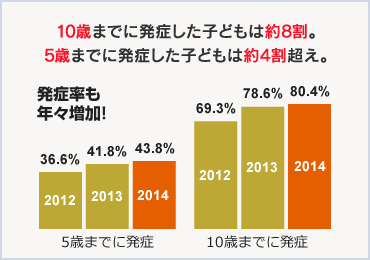
Approximately 30% of parents with children up to 16 years old report experiencing "hay fever in their children."
Hay fever is becoming more common in younger people.

*2012 data: Survey conducted in December 2012. Results of a questionnaire survey of 2,587 parents with children aged 0-16 and 4,371 of their children. 2013 data: Survey conducted from November to December 2013. Results of a questionnaire survey of 2,082 parents with children aged 0-16 and 3,475 of their children. 2014 data: Survey conducted in December 2014. Results of a questionnaire survey of 1,522 parents with children aged 0-16 and 2,452 of their children (conducted by Rohto Pharmaceutical Co., Ltd.)

What kind of pollen are you reacting to?

Check the pollen season!

You can check which pollen you're reacting to based on when your symptoms typically appear.
If you know which pollen causes your symptoms, check the pollen dispersal period and take precautions early!

  • Hokkaido
  • Tohoku
  • Kanto
  • Kansai
  • Kyushu

*Quoted from the 2013 edition of the Nasal Allergy Treatment Guidelines.