Everyone's efforts to conceive

Since 2018, Rohto Pharmaceutical has been listening to the real voices of people surrounding fertility treatment, pregnancy, and childbirth, and has continued to publish this information in the form of the "Fertility Treatment White Paper." This year, marking the eighth edition, we have once again confronted the existence of "invisible walls" that people face in today's world where diverse life plans are envisioned. As times have changed, the choices of how to live have expanded greatly, but at the same time, there are many people who are filled with anxiety and uncertainty because they do not have enough information to think about the future. While respecting the individual choice of whether or not to want children, we have sought hints for taking a new step forward as a society so that everyone can envision a future that they can be satisfied with.

Intentions of unmarried men and women to have children

For the first time, the percentage of women who do not want children in the future has surpassed that of men, reaching a record high of 64.7%.

  • 18-29 years old, unmarried men and women

The number of unmarried men and women (18-29 years old) who want to have children in the future continued to decline from last year, while the percentage of those who do not want children in the future rose by approximately 6 percentage points from last year to a new record high of 62.6%. Furthermore, for the first time since the survey began in 2018, the percentage of women who answered that they do not want children exceeded the percentage of men.

  • 6% of people want to have children in the future.
  • 6% of people do not want children in the future.

Intentions of unmarried men and women to have children

Up to age 24, the number of people who "want children in the future" outweighs those who "don't want children." The desire for children tends to decrease with age.

  • 18-39 year old unmarried men and women *

*SCR survey results

For both unmarried men and women (ages 18-39), the peak age for wanting children is around 20. The number of people who want children in the future outweighs those who do not until age 24, revealing the existence of a "25-year-old wall" where intentions reverse. It was also found that the number of people who want children tends to decrease with age.
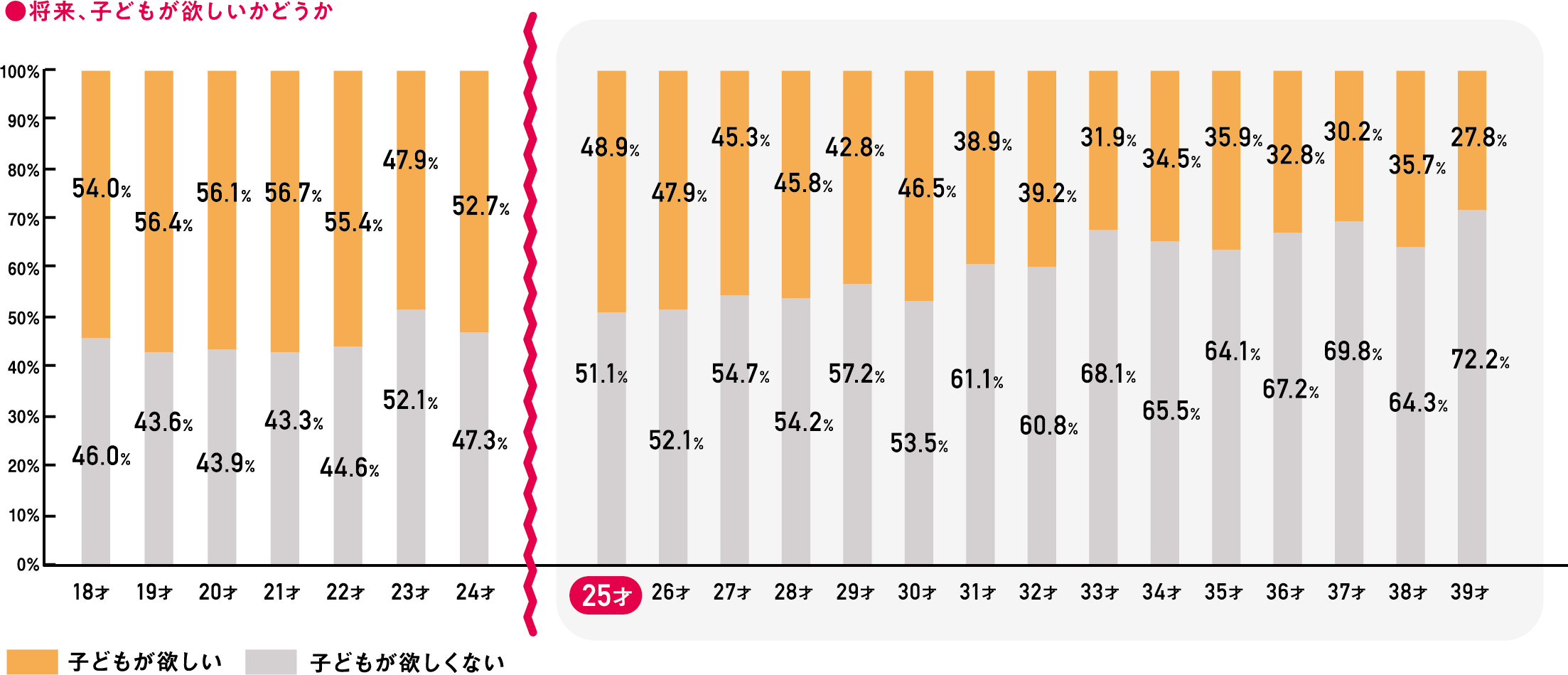
Do you want to have children in the future?

Attitudes of unmarried people who want children

For unmarried people who want children, the desired age for having their first child is being pushed back to their 30s or later. Women, in particular, feel more anxious than men about the career interruption and financial concerns associated with having children.

  • 18-29 years old, unmarried men and women

Regarding the desired age for having a first child among young, unmarried men and women who wish to have children in the future, in 2018, approximately 1 in 2.5 people (39.0%) wanted to have their first child by the age of 30. However, by 2025, this figure is projected to decrease to approximately 1 in 4 people (25.2%). The number of people hoping to have a first child in their 30s or later is increasing, indicating a shift in the desired age for having a first child. (The average age is 31.3 years old.)
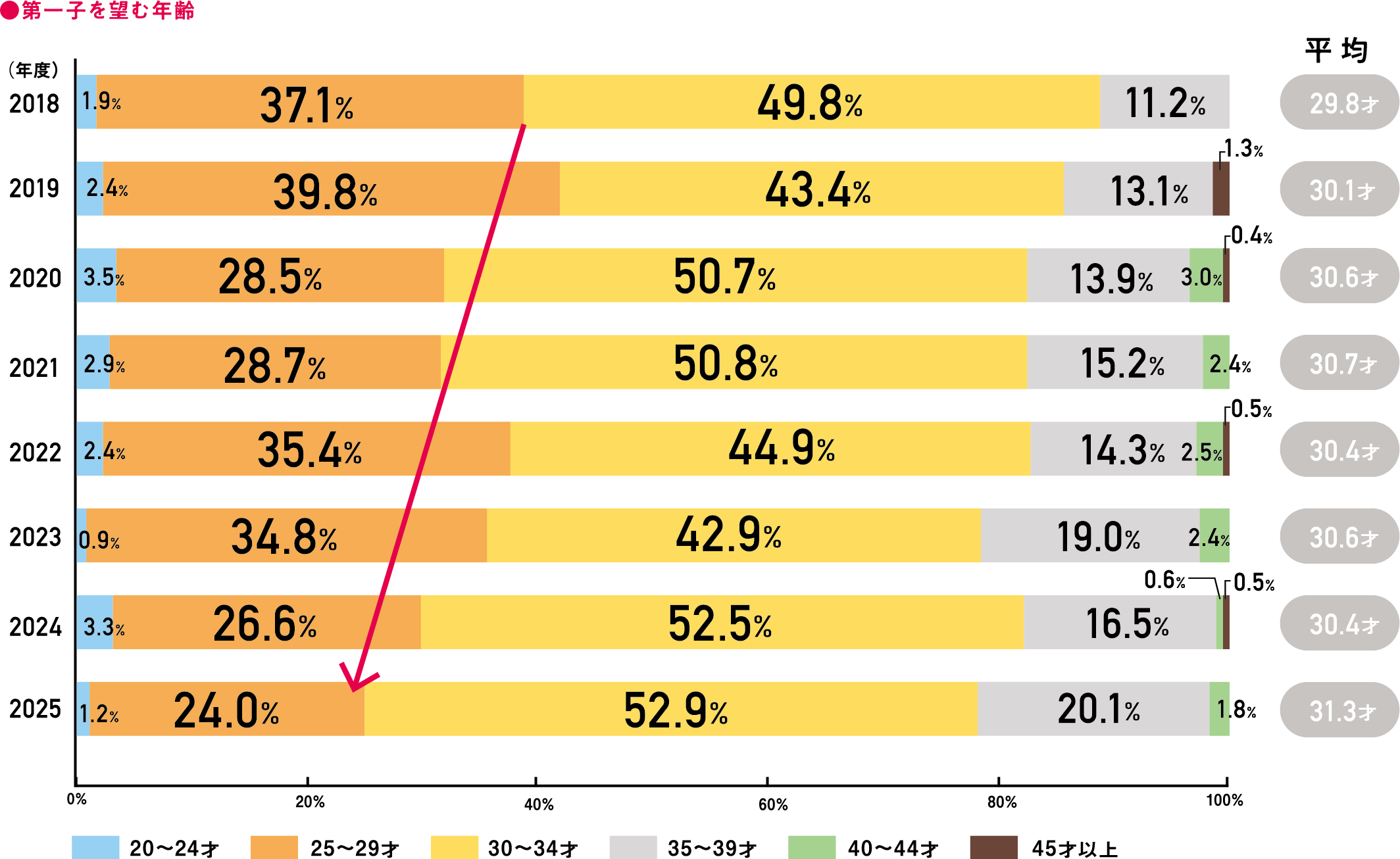
The age at which people want their first child

More than half of young, unmarried men and women are concerned about the "financial burden" and "impediment to their careers" that comes with having and raising children. Furthermore, the percentages for both concerns were nearly 10% higher among women than men, indicating that women are more anxious about these issues.

  • I am afraid of the financial burden of having and raising children.
  • I feel that having children will hinder my career.

Obstacles before trying to conceive: Wanting to conceive but not receiving the necessary information.

More than half of unmarried men and women who want children have not yet started gathering information about pregnancy and childbirth, and more than 60% are unaware of the existence of support for the cost of medical examinations at clinics.

  • 18-39 years old, unmarried men and women

Even among unmarried men and women who desire children, more than half have not yet begun gathering information, and their average score on quizzes about pregnancy and childbirth was lower than that of those who do not desire children.

The age at which people started gathering information about fertility treatment and childbirth, either with fertility treatment in mind or with their own life and career plans in mind.

Correct answer rate for quizzes about pregnancy and childbirth

Among unmarried men and women who wish to have children, more than 60% were unaware of the existence of local governments that support AMH testing and infertility treatment, and more than half responded that they were unaware that some infertility treatments are covered by insurance.

Things you should know about pregnancy and childbirth

Obstacles during fertility treatment #1: Difficulty starting fertility treatment as desired.

Over 40% of women who have tried to conceive and gave birth in their early 30s said that they started trying to conceive later than they had hoped due to a lack of knowledge about fertility. Also, about 60% of those who have tried to conceive felt that they "wish they had learned about it sooner."

  • Men and women aged 18-49 with experience trying to conceive.

Among women who had tried to conceive and gave birth in their early 30s, more than 40% responded that they "started trying to conceive later than they had hoped." This suggests that, in addition to a lack of information and anxiety about fertility treatment, they prioritized work commitments and career advancement.
*To clarify whether women who are in the transitional period between a crucial career development phase and a time when their biological fertility changes were actually able to conceive at their desired time, we focused on the scores of women who gave birth in their early 30s.

When did you start trying to conceive, and why were you unable to start trying to conceive at your desired time?

Approximately 80% of people began gathering information about pregnancy and childbirth after getting married, with fertility treatment and their own life plans in mind. However, 58.3% of men and 67.6% of women who have tried to conceive said that "getting pregnant is more difficult than they imagined before starting to try to conceive." It was also revealed that about 60% of those who have tried to conceive felt that "they wished they had learned about it sooner."

  • The time when you start gathering information about fertility treatment and childbirth, either because you are thinking about trying to conceive, or because you are thinking about your own life plan or career plan.
  • Attitudes towards fertility treatment (overall among men and women with experience in fertility treatment)

Obstacles during fertility treatment (Part 2): Understanding and support for fertility treatment in the workplace.

Approximately 40% of married men and women have not been able to talk to anyone about their fertility treatment plans.
Furthermore, only about 4% of respondents said they would consult with their supervisor or colleagues at work.

  • Married men and women aged 25-44

A survey revealed that over 40% of married men and women have no one to talk to about their fertility treatment plans. Of these, only about 4% consult their superiors or colleagues at work, suggesting that many feel it's difficult to gain understanding for fertility treatment in the workplace.

A confidant for those trying to conceive

Married women are more than 10 percentage points higher than married men in considering changes to their career plans, such as feeling that having children may hinder their careers or considering changing jobs or transfers in order to raise children.

  • I feel that having children will hinder my career.
  • I am considering changing jobs or transferring to a different department as I have children and am raising them.

Advice from people who have tried to conceive

For those about to begin their journey to conceive, we've gathered advice from people who have already gone through the process. This book is packed with tips to help you create a life plan that suits you and make choices you can be proud of.

For those who think that trying to conceive is still a long way off

Gather knowledge as early as possible.

  • It's important for couples to discuss their respective health, careers, and timing early on. It's not a case of "you'll get pregnant eventually if you don't use contraception," so it's crucial to have accurate knowledge. (Woman in her early 20s)
  • I believe that thinking about and researching these issues from a young age, while you're in your teens or twenties, allows for early intervention and reduces the risk. By your thirties and forties, you tend to become physically weaker, so you're more likely to feel tired and have less mental resilience. (Male, late 30s)

I want a child.
Whether you want it or not, get tested at least once.

  • Whether you want children or not, it doesn't hurt to get a gynecological checkup. Some people are successful when they start trying to conceive, while others are not, so it's best not to compare yourself to others and to proceed at your own pace. (Woman in her late 30s)
  • In any case, getting things done as soon as possible is key to success. I think you should at least get checked out as soon as you notice something is wrong. I felt that knowing or not knowing the condition of your own body makes a huge difference. (Woman, late 30s)

I'm thinking of starting to work on this.
Towards people

Align your feelings and steps with your partner.

  • Before even considering whether or not a couple can conceive, it's crucial for them to have a proper discussion about each other's feelings. If only one person's feelings are considered, they won't be able to cooperate effectively, and even after having a child, misunderstandings and differences in perspectives will arise. (Male, early 40s)
  • How many children do you want to have with your partner, and by what age do you want them? How much money are you willing to spend? What specific steps will you take? It's important for couples to clearly understand each other's plans, expectations, and pace. It's also crucial to maintain open communication and cooperation even after starting to try to conceive. (Woman in her early 30s)

Instead of "waiting" for understanding from the workplace
To "Create/Choose"

  • Trying to time things with the workplace is just a waste of your own and your child's lives. It's more important to try to conceive at your own timing and to get your workplace to understand and support pregnancy and childbirth. (Male, late 20s)
  • I think it's a good idea to check whether the workplace offers support for fertility treatment when you're looking for a job. (Woman in her late 20s)

Don't be too nervous,
Consult with someone you trust.

  • The internet is overflowing with all sorts of information, which can easily lead to excessive depression or bottling up your feelings. Often, you feel like talking to anyone who isn't directly involved is pointless. I felt that my partner and my obstetrician/gynecologist were the only people I could truly trust and talk to, so I urge you to talk to them as much as you can and try not to let your stress build up. (Woman in her late 20s)

Sign ① <Increased awareness of self-care>

Self-care awareness among married men and women has increased over the past three years.
On the other hand, awareness of preconception care is only about 20%.

  • Married men and women aged 25-44

Among married men and women, there has been an increasing trend in the implementation rate of so-called preconception care, such as "discussing life plans with one's partner," "paying attention to one's partner's health," and "reducing smoking." On the other hand, awareness of preconception care remains at only about 20% among married men and women.

Things I'm currently working on in preparation for pregnancy and childbirth
Awareness of "preconception care"

Sign #2: <Improved satisfaction with fertility treatment and increased rate of couples trying to conceive together>

Both men and women with experience in fertility treatment saw improvements in "satisfaction with fertility treatment" and "the rate of couples actively participating in fertility treatment." In particular, men saw their satisfaction increase by more than 15 points due to changes in their proactive behavior.

  • Men and women aged 18-49 with experience trying to conceive.

Satisfaction levels among men and women who have tried to conceive, as well as the rate of couples trying to conceive together, have improved significantly since last year, with this trend being particularly pronounced among men. It appears that the increase in "men trying to conceive" who are considerate of their partners and take proactive steps, such as having a shared understanding of their desire for children and how to proceed, and reviewing each other's lifestyles, is driving this overall improvement.

I am satisfied with my efforts to conceive.
Things we're doing as a couple trying to conceive

Correct answers to quizzes about pregnancy and childbirth

Q. If you have your period every month, does that mean you are ovulating?

A. (×)Even if you have a period every month, it may be an anovulatory cycle.

Q. You can determine the correct ovulation day by measuring your basal body temperature, so it's best to time intercourse as soon as you notice a rise in basal body temperature.

A. (×)When basal body temperature rises, ovulation has often already finished.

Q. The most appropriate time to time intercourse for conception is the day of ovulation and the following day.

A. (×)The most fertile time to conceive is to have intercourse one to two days before ovulation.
However, pregnancy is still possible even the day after ovulation.

Q. A woman's ability to conceive gradually begins to decline from around the age of 40.

A. (×)A woman's ability to conceive gradually begins to decline from around the age of 35.

Q. Can a woman increase the number of her eggs through efforts such as training and diet?

A. (×)The number of eggs is determined before birth and cannot be increased through training or diet.

Q. If frozen eggs are thawed and fertilized, will all of them be successfully fertilized and lead to pregnancy and childbirth?

A. (×)Not all frozen eggs will be fertilized and develop normally after thawing, and there is a limit to the percentage that result in pregnancy and childbirth.

Q. Even with lump-sum payments and subsidies, childbirth expenses often result in out-of-pocket expenses of 500,000 yen or more.

A. (×)Because there is a system in place where the 500,000 yen lump-sum childbirth and childcare allowance is used to cover the medical expenses for childbirth, it is not common for the out-of-pocket cost for a normal delivery to exceed 500,000 yen.

Q. If a man is producing sperm, is he capable of impregnating a woman?

A. (×)Even if sperm are produced, reproduction may not be possible if there are problems with motility, sperm count, ejaculation failure, or erectile dysfunction.

Q. When a healthy 30-year-old couple has intercourse at the right time, the probability of conceiving a child on the first try is over 50%.

A. (×)It is said that the probability of a healthy 30-year-old couple conceiving a child on the first try when they time intercourse correctly is approximately 30%.

To be close to each individual's "present moment",
Supporting you in creating your own unique future.

The survey revealed a variety of attitudes and anxieties regarding fertility treatment.
Rohto Pharmaceutical Co., Ltd. disseminates information through various platforms to deliver accurate knowledge.

Learn the basics of trying to conceive and getting pregnant

A Beginner's Guide to Trying to Conceive

A first-step guide to trying to conceive, answering the question, "Where do I even begin?"

A Beginner's Guide to Trying to Conceive

Knowing what a healthy body is

Women's Body Navigation

From pregnancy to post-pregnancy health, this self-care media platform helps you deeply understand your own body.

Women's Body Navigation

Fertility-related knowledge web animation

Don't give up, little egg!

Here are some hints to bridge the knowledge gap between men and women.
A slightly bittersweet and endearing story that you can laugh and learn from together with your partner.

Don't give up, little egg!

Rohto Pharmaceutical Co., Ltd. values the insights gained from this survey.
We declare that we will continue to walk this path together with all of you.

This survey revealed that many people find it difficult to give immediate answers about their future. Concerns about the unpredictable impact on their careers and a lack of knowledge about fertility treatment and pregnancy are contributing factors. These feelings combine, and it seems that many people are postponing making decisions, thinking, "Maybe I don't need to think about it yet." We strongly felt that such an "invisible wall" exists before people even begin considering fertility treatment.

On the other hand, signs of new hope are also emerging. These include an increase in "men actively pursuing fertility treatment" who show consideration for their partners, and a growing awareness of "preconception care," which involves self-care in preparation for the future. We believe this positive attitude is the key to transforming doubt and regret into "satisfying choices." Whether or not one desires children, with the right knowledge, there should be a future where one can choose at their own pace and with conviction. And we hope that this will not be a matter solely for individuals or couples, but a world where society as a whole can support each other.
Rohto Pharmaceutical will continue to listen to the voices of each and every individual living in an ever-changing society, and together with you, we want to create a future where everyone can make choices that are true to themselves, at their own pace.