Everyone's efforts to conceive

Rohto Pharmaceutical advocates "Two-Person Fertility Treatment" through its brand and corporate activities, emphasizing that both women and men should face the fertility treatment process together with their partners.
While continuing to support couples trying to conceive, we want to be more attentive to the real voices and concerns of a wide range of people, not just those trying to conceive, but also those involved in fertility treatment, pregnancy, and childbirth, and think together with them. In the midst of diverse values and changing lifestyles, we hope that a society where people cherish themselves and their partners, take care of their minds and bodies before trying to conceive, live healthily, and live authentically and in their own way, will become more commonplace. With this in mind, we changed the title of our fertility treatment white paper from "The Current State of Couples Trying to Conceive" to "Everyone's Fertility Treatment" this year.

Changes in attitudes towards "trying to conceive as a couple"

The rate of couples trying to conceive has returned to pre-COVID levels.

  • Married men and women

The adoption rate of "two-person fertility treatment," where both women and men face the challenge together and move forward side by side with their partner, has been on a downward trend since last year, but is returning to pre-COVID levels.

The rate of couples trying to conceive has returned to pre-COVID levels.

Intentions of unmarried men and women to have children

Approximately half of them say they "don't want children in the future."

  • Young unmarried men and women

We are asking people over time whether they want children now and in the future. Over the past three years, the percentage of 18-29 year olds who answered "I don't want children" has been gradually increasing from just over 40% overall.
Looking at the data by gender, we see an increase for both men and women from 2020 to 2022. In particular, more than half of men this year said they did not want children.

  • Do you want to have children in the future?
  • I don't want children in the future.

Reasons for not wanting children

Anxiety about the future is raising the bar for having children.

  • Young unmarried men and women

We are asking unmarried men and women aged 18 to 29 about their reasons for not wanting children.

Reasons for not wanting children

It appears that many people are struggling just to survive, and are filled with concerns and anxieties about pregnancy, childbirth, child-rearing, and the future. The hurdles people face in having and raising children seem to be quite high.

So, what kind of mindset do people who are trying to conceive in modern times have?
What kind of projects are you working on?

What is "fertility treatment"?

More than half of people perceive "fertility treatment" as "something that everyone who wants children does."

  • Married men and women

Over the past five years, there has been a growing trend in how people perceive "fertility treatment" (or "trying to conceive"), shifting from viewing it as something that only those who desire children do. This suggests a broadening of people's understanding of fertility treatment.

More than half of people perceive "fertility treatment" as "something that everyone who wants children does."

What are you doing as part of your "fertility treatment"?

Approaches to "fertility treatment" are shifting towards a more interactive model.

  • Married men and women

There are signs that fertility treatment is now being seen not only as actions directly related to pregnancy, such as visiting a clinic or engaging in sexual intercourse, but also as everyday activities like discussing future life plans together and managing one's health.

Approaches to "fertility treatment" are shifting towards a more interactive model.

Reasons for not wanting children

While the number of young people who feel anxious about having children in the future is increasing, the actions taken for "fertility treatment" are gradually becoming more commonplace, and it has become clear that people who want children in the future are shifting their mindset to starting with what they can do themselves.

Health management before pregnancy is called "preconception care." The CDC (Centers for Disease Control and Prevention) advocates the importance of all women and men being healthy before pregnancy, regardless of whether they plan to become pregnant in the future. This is because it protects the health of any children that may be born in the future and contributes to their own lifelong health. This is an initiative that is being promoted internationally.

U.S. Centers for Disease Control and Prevention (CDC)
https://www.cdc.gov/preconception/overview.html

"Preconception Care"
(Regarding health management before pregnancy)

Have you heard of "preconception care" (health management before pregnancy)?

  • Married men and women
  • Young unmarried men and women

Both married and unmarried respondents, 80-90%, said they were unfamiliar with the term "preconception care." This indicates that most people are unaware of it.

Have you heard of "preconception care" (health management before pregnancy)?

Knowledge about one's own body and health

Even if you don't know the words,
Knowledge about the body and health is spreading.

  • Married men and women
  • Young unmarried men and women

In particular, among married men and women, only about 20% responded that they "don't know any of this information," suggesting that the remaining 80% possess some knowledge. It has become clear that knowledge about health management before pregnancy, including information related to the bodies of women and men individually, as well as information related to both sexes, is spreading. Even if people are not familiar with the term "preconception care," it seems that knowledge about their own bodies and health is already spreading.

Even without knowing the words, knowledge about the body and health is expanding.

"Preconception Care"
Actions related to "health management before pregnancy"

Even though many people possess the knowledge, few actually take action to perform self-checks and care.

  • Married men and women
  • Young unmarried men and women

The results showed that approximately 30% of married men and women engage in daily health and physical management, as well as communication with their partners, while less than 20% engage in self-checks and self-care related to pregnancy.

Even though many people possess the knowledge, few actually take action to perform self-checks and care.

I haven't been able to take action yet,
For what we will be working on from now on
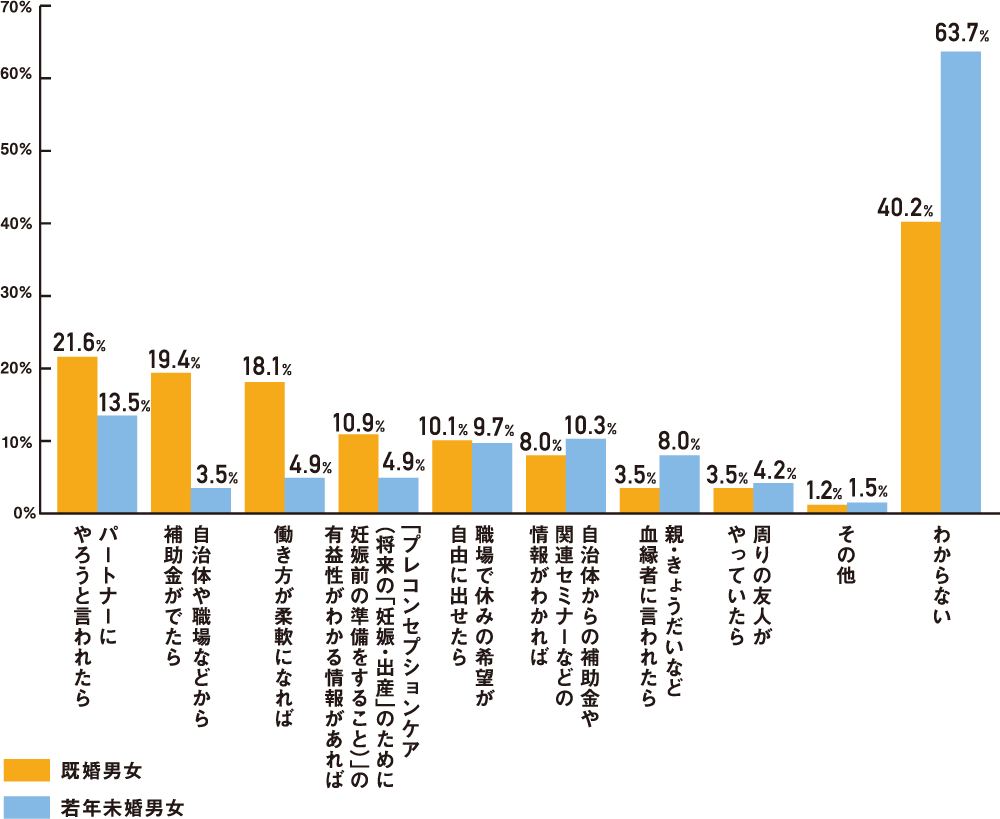
What could be the trigger?

  • Married men and women
  • Young unmarried men and women

I haven't taken action yet, but what could be the trigger to start working on it in the future?

Now that knowledge is beginning to spread, what kind of triggers are needed to translate that knowledge into more action in the future?

While it's just a sign, advice from a partner, regardless of marital status, seems likely to be a catalyst for action. Furthermore, for married individuals in particular, increased support from the workplace and local government could potentially encourage preconception care (health management before pregnancy). Ultimately, it seems necessary for information, support, and systems to become more readily available and widespread within the workplace and community, which are central to our lives.

In today's world, the number of people who say they don't want children in the future is increasing year by year. We also heard many voices from people who don't have a positive image of pregnancy, childbirth, and child-rearing due to anxieties about the future. In this changing society and environment, and in a world where diverse values are spreading, we were also able to catch a glimpse of the voices and realities of people who are gaining knowledge about their own bodies and health and facing fertility treatments in a positive way.
People who feel anxious about having children are not necessarily lacking in knowledge; they may simply need incentives or support systems to encourage them to take action.
Preconception care is about understanding and taking action regarding your own body and health, for your own sake and for your future, regardless of whether you hope to have children in the future. Taking care of yourself and valuing yourself, deepening your understanding with your partner and working together on "pregnancy planning as a couple," and creating a supportive societal environment are becoming increasingly important.
At Rohto Pharmaceutical, we will continue our efforts to raise awareness and take action regarding proactive physical health so that each individual can live a well-being-oriented life in their own way. Furthermore, we want to listen to the voices of "everyone" and work together with those who are creating society and the future, transcending the boundaries of companies and industries.

My body, our well-being