Our current journey trying to conceive as a couple
It has been about two years since the start of the COVID-19 pandemic.
As society as a whole changes and a new normal emerges, a diverse range of approaches to fertility treatment are becoming apparent.
We asked couples who are currently considering trying to conceive about the changes in their circumstances, realities, and their true feelings.
Changes in awareness regarding couples trying to conceive
The number of people who are "trying to conceive as a couple" is increasing.
Last year, there was a significant increase in the perception that "we are able to conceive together as a couple." Although the numbers have stabilized this year, there has been a gradual upward trend over the four years since 2018. In particular, the number for men has increased by about 20 points from the lowest point in 2019. This suggests that the awareness that conceiving is something that couples should do together is becoming more established.
Changes in attitudes towards trying to conceive over the past year
Positive feelings towards trying to conceive are gradually recovering.
Over the past year, health awareness for oneself and one's partner has been on a downward trend. It seems that the heightened health awareness during the COVID-19 pandemic has subsided for the time being. On the other hand, attitudes such as "I feel more positive and proactive about trying to conceive" and "I feel more at ease" have increased. This suggests that the mindset towards trying to conceive, which had been on the decline due to the impact of the new coronavirus, is gradually recovering.
We found that people trying to conceive have gradually regained a positive outlook over the past year.
We explored the thoughts and realities of people who have experienced the COVID-19 pandemic and the resulting social changes, to see what values they now hold and how they approach and engage with fertility treatment.
Six types of fertility treatments and their characteristics
Based on various backgrounds, there are six distinctive types of fertility treatments.
Based on this survey, a random analysis revealed that six distinctive types of fertility treatment exist, stemming from diverse values, relationships with those around them, and environmental factors. Each type is characterized by five factors: "going at one's own pace," "understanding from those around them and society," "understanding from their partner," "use of tools and services," and "support environment from local government and the workplace."
Each type of fertility treatment and satisfaction level
• Relationship with the duration of fertility treatment
As the duration of fertility treatment progresses, the type of treatment and level of satisfaction change.
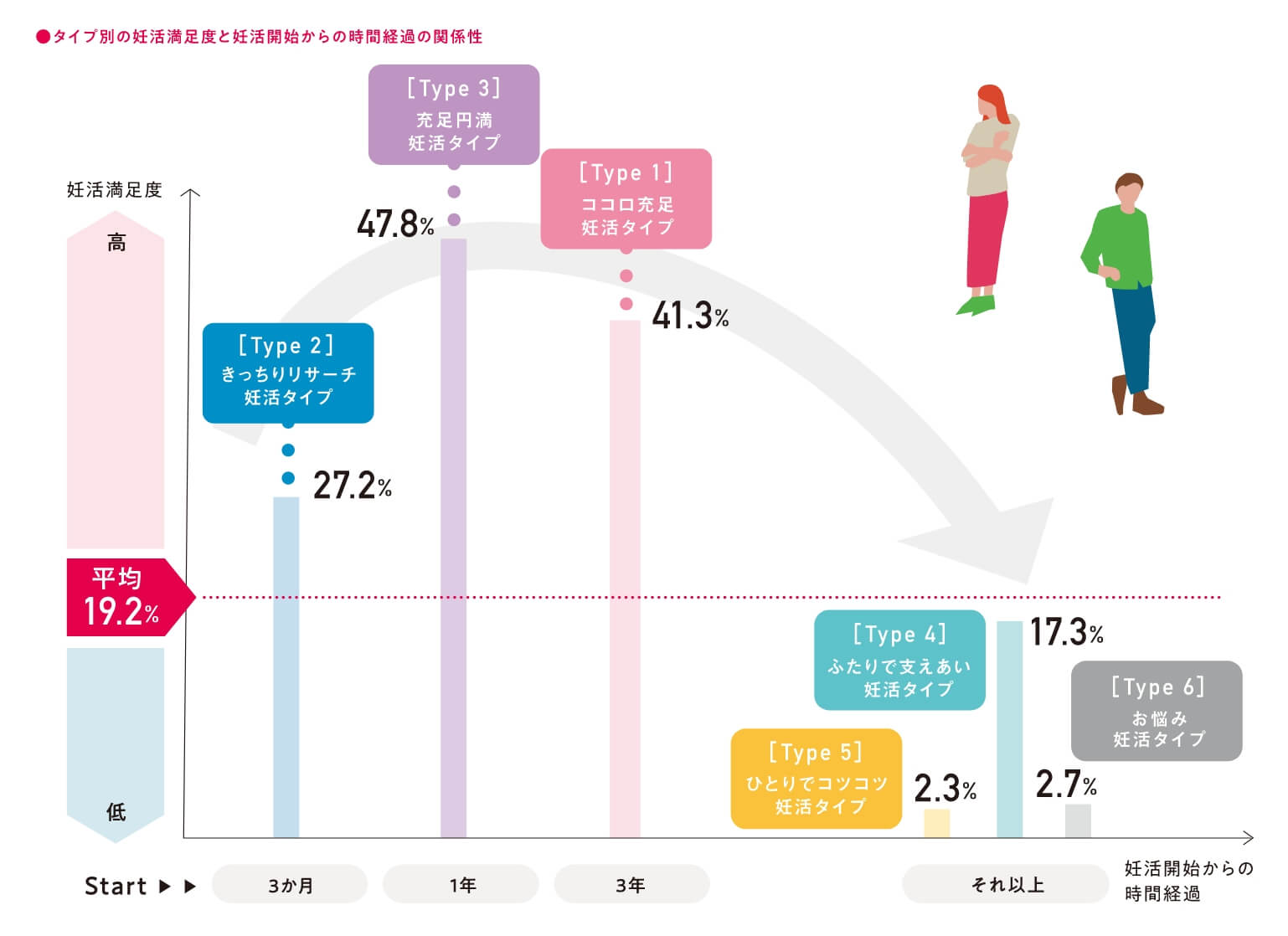
When analyzing fertility treatment types based on satisfaction with fertility treatment and duration of fertility treatment, a tendency emerged for each type to be distributed according to the duration of fertility treatment. In the early stages of fertility treatment, there were many "thorough research types" who started by gathering information one by one, then around the first year of fertility treatment, there were many "fulfilling and harmonious types" who were progressing smoothly, and even after some time had passed, there were many "emotionally fulfilling fertility treatment types" who were able to engage in satisfying fertility treatment with the support of understanding partners and those around them. This reveals that people undergoing fertility treatment do not remain fixed in one type, but rather change with the duration of their efforts.
Types 1, 2, and 3 of fertility treatment showed a high rate of couples actively trying to conceive together, and this correlated with a higher level of satisfaction with the fertility treatment process.
Furthermore, it seems that satisfaction with the fertility treatment process tends to decrease as it becomes more prolonged.
<Three points to help you approach fertility treatment positively, even if it becomes a long-term process>
① Understanding and actions of your partner
Partner's understanding and actions are essential.
Both the "mutually supportive" and "solo, steady" types engage in long-term fertility treatment, but there was a difference in their satisfaction with their fertility journey. It became clear that there was a significant difference in their perception of whether or not they were truly engaging in fertility treatment as a couple. Furthermore, the "solo, steady" type seemed to have a stronger image of fertility treatment as something "difficult" and "something only women do." In other words, it seems that understanding and action from one's partner are necessary to overcome the challenges of long-term fertility treatment with a positive attitude.
② Support from those around you
Support from those around you is also effective.
For those who prefer to work diligently on their own, "pressure from those around them" is a major factor in the difficulties of trying to conceive, and "same-sex friends" with whom they can discuss their fertility journey are extremely important. They also have a higher need for government support compared to other types, and seem to require "places for consultation and information exchange," "seminars, information sessions, and workshops on fertility treatment," and easy access to such information and support.

③ Accurate information about fertility treatment
Accurate information about fertility treatment
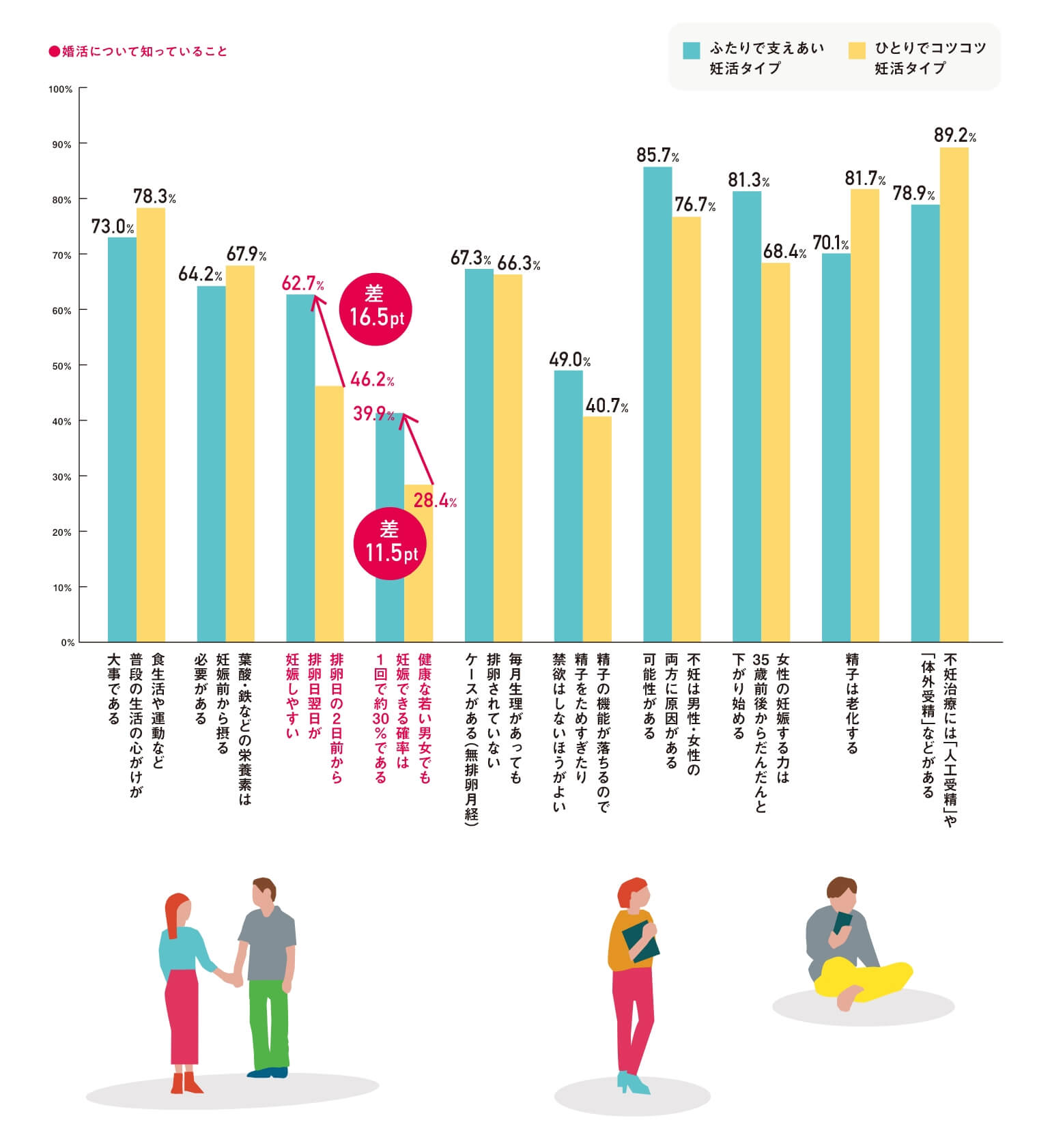
The "couple-supportive fertility treatment type," which has a high level of satisfaction with fertility treatment, is revealed to know important information about fertility treatment, such as "the period from two days before ovulation to the day after ovulation is the most fertile time*¹" and "even healthy young men and women have only about a 30% chance of getting pregnant on their first try*²," compared to the "solo fertility treatment type," which has a low level of satisfaction with fertility treatment. It seems necessary to design information channels, especially for the "solo fertility treatment type," to convey accurate fertility knowledge, including through same-sex friends.
*1 "Things you should know about pregnancy and childbirth if you're trying to conceive" https://jp.rohto.com/dotest/lnln/13/
*2 "A Beginner's Guide to Trying to Conceive" https://jp.rohto.com/dotest/guide/ninkatsu/
Two years have passed since the COVID-19 pandemic began in earnest at the start of 2020.
2021 was a year of significant societal change, and people's lifestyles have also undergone major transformations. We can see that people are gradually adapting to these new habits. At the same time, while there have been positive changes such as a shift towards a more accepting society and increased emphasis on diverse values in fertility treatment, it has also become clear that there is still a need to improve the support system and social environment so that people can make choices that are true to themselves while undergoing fertility treatment, in line with these diverse values. We at Rohto Pharmaceutical aim to create a society where people who are considering fertility treatment, those who do not wish to conceive, and those who have decided to stop fertility treatment can make choices and live true to themselves. And a society where there is sufficient information, solutions, and environment to support this. With this well-being society in mind, we will continue to stand by your feelings and support you.