Everyone's efforts to conceive

Amidst a social environment of declining birth rates, last year's "White Paper on Fertility Treatment" revealed that even among those who feel they "don't want children," there are those who "want to keep the possibility of conceiving open," suggesting a glimpse of a diversification in attitudes towards fertility treatment.
Based on this, in this year's seventh annual "White Paper on Fertility Treatment," we expanded the scope of the survey and the number of items included in order to gain a more concrete understanding of the diverse attitudes toward fertility treatment, pregnancy, and childbirth that lie behind the sentiment of "not wanting children."
In today's world, where happiness takes many forms and the search for one's own identity can bring both hope and anxiety, how should we, in the Reiwa era, navigate our future? This project aims to explore "hints" for the future that can be gleaned from the realities of today.

Intentions of unmarried men and women to have children

A record high of 56.6% of young, unmarried men and women believe they do not want children now or in the future.

  • Young unmarried men and women

The percentage of unmarried men and women (18-29 years old) who do not want children now or in the future has increased since the 2020 measurement, reaching a record high of 56.6% this year. Looking at the data by gender, approximately 60% of men responded that they do not want children in the future, and once again this year, a higher percentage of men than women expressed this sentiment.

  • A record high of 56.6% of young, unmarried men and women believe they do not want children now or in the future.
  • A record high of 56.6% of young, unmarried men and women believe they do not want children now or in the future.

I want to keep the possibility of having children open.

This year, among men and women who do not wish to have children, about one in four are "preparing for fertility treatment"—those who want to keep the possibility of having children open. This is a slight increase from last year, with a particularly noticeable rise among men.

  • Young unmarried men and women
  • Men and women who do not want children

Continuing from last year, approximately one in four unmarried men and women who said they did not want children said they wanted to maintain a physical ability to conceive so that they could have children in the future if their feelings changed. Compared to last year, the number of people preparing for fertility treatment has slightly increased overall, and the number of men preparing for fertility treatment has increased particularly. This shows that even though the number of people who want children has decreased, the number of people preparing for fertility treatment has increased.

There are those who are "preparing for conception."

Fertility treatment actions

The rate of married men and women engaging in fertility treatment has increased over the past three years. Furthermore, men are becoming more proactive in fertility treatment, and many people, regardless of gender, feel that fertility treatment is something relevant to their lives.

  • Married men and women

On the other hand, when married men and women were asked about what they were doing to try to conceive, there was an increasing trend in responses such as "talking about family planning with my spouse," "having intercourse on the day of ovulation," and "asking others for information."

Fertility treatment actions

Even focusing solely on men, each score is higher than in the surveys of the past three years, suggesting that there is a growing interest in fertility treatment among both men and women.

Fertility treatment actions

Fertility-related actions / Men's interest in fertility treatment

Men in their late 20s, in particular, tend to be more proactive in trying to conceive.
The rate of men actively trying to conceive is about 1.5 times higher than the overall rate for men, and among them, the rate of women actively trying to conceive is particularly high.
Men tend to be more considerate of their health and are more likely to talk to other men about fertility treatment.

  • Experience with trying to conceive
  • male

Among men with experience in trying to conceive, those in their late 20s proactively communicated with their partners and learned about pregnancy and fertility treatment together. They also discussed fertility treatment with other men, demonstrating an open approach to gathering information.

Fertility treatment actions

Fertility treatment actions

Attitudes toward having children

Among those who have tried to conceive and are currently actively seeking children, approximately 50% have changed from being reluctant to having children to being actively seeking them. This clearly shows that attitudes towards wanting children are easily shifted.

  • Men and women with experience trying to conceive

This year saw a record high number of young, unmarried men and women who do not want children. However, among those who have gone through fertility treatments and now believe that having children is a good thing, 49.6% responded that they "were not sure before whether they wanted children" or "did not want children before." This result clearly shows that attitudes towards having children are easily changed.

Attitudes toward having children

Gender differences in attitudes towards having children

The timing for women to seriously consider having children is "their age" and "after marriage," while for men it's "during dating." Women begin thinking about having children based on "their own circumstances," while men begin thinking about it based on "their relationship with their partner."

  • Men and women with experience trying to conceive

When we asked men and women who had tried to conceive and whose views on having children had changed, about 30% of the women said their age or their experience in marriage had made them more positive about having children. On the other hand, about 30% of the men said they began to consider having children while dating their spouse.

Gender differences in attitudes towards having children

Attitudes toward fertility treatment

When categorized by their approach to fertility treatment, "5 Types of Fertility Treatment in the Reiwa Era" were revealed.

  • Men and women aged 18-44 without children *

*Those who do not want children at all are excluded.

Attitudes towards having children are constantly changing, and perspectives are becoming increasingly diverse.
To understand attitudes toward fertility treatment, we categorized men and women without children into five types based on their level of practice in fertility treatment and preconception care, as well as the strength of their desire to have children.

  • Attitudes toward fertility treatment
  • Attitudes toward fertility treatment
  • Attitudes toward fertility treatment
  • Attitudes toward fertility treatment
  • Attitudes toward fertility treatment

The reality varies greatly, from those who are eager to conceive to those who are hesitant about having children.

There were significant differences in the amount of knowledge, information access, and life planning related to fertility treatment among the participants, and their anxieties also varied.

From here, we will introduce the characteristics of each of the five types. We have also included "recommended first steps" for each type.
I hope this will be helpful when you decide to start trying to conceive.

We're steadily working on getting pregnant together.

TYPE01

Working together with my partner to try to conceive,
A type of person who actively desires to have and raise children.

Features

  • This type is the most actively pursuing fertility treatments and has a high priority on having and raising children.
  • I often discuss life plans with my partner and we think concretely about the future.
  • They possess extensive knowledge about pregnancy and childbirth, and have significantly more internet research experience compared to other types of people.
  • Many people are worried about their own physical constitution, and more than half are concerned that they may have difficulty conceiving.
  • We're steadily working on getting pregnant together.
  • We're steadily working on getting pregnant together.
  • We're steadily working on getting pregnant together.
  • We're steadily working on getting pregnant together.

Recommended first step

Make it a habit to self-check with over-the-counter medications.
I also receive regular checkups and guidance at the hospital.

Voices from people who have tried to conceive

  • Take it easy! Set time limits to build a relationship where you and your spouse can enjoy spending time together!
    (Female in her early 40s)
  • I understand your anxiety, but I think it would be best if we could support each other and work together to do what we can, one step at a time, without rushing.
    (Male, early 30s)

The two of them are happily taking their time to try and conceive.

TYPE02

I want to have and raise children someday,
Type of person who values their relationship with their partner

Features

  • While having and raising children is a high priority, the relationship and time spent with one's partner are paramount.
  • I frequently discuss my life plan with my partner and also take preconception care measures such as paying attention to my diet.
  • Similar to the "steady fertility treatment" type, 20% of this type undergo examinations and general infertility treatments at obstetrics and gynecology clinics or other medical facilities.
  • They have more anxiety about getting pregnant than couples who are "steadily trying to conceive together." They particularly feel that there is a lack of places to talk to about fertility issues.
  • The two of them are happily taking their time to try and conceive.
  • The two of them are happily taking their time to try and conceive.
  • The two of them are happily taking their time to try and conceive.
  • The two of them are happily taking their time to try and conceive.

Recommended first step

First, we need to understand your current health condition.
Adjusting lifestyle habits in preparation for pregnancy and childbirth

Voices from people who have tried to conceive

  • I would be grateful if I had someone other than my partner I could talk to.
    (Female in her early 30s)
  • Every couple has a different way of facing their relationship, so I hope they can find the right approach for them.
    (Male, early 40s)

I'm interested, but I'm stuck in a loop of trying to conceive.

TYPE03

Although they have a strong desire to conceive, their relationship with their partner and their financial situation are factors.
A type of person who feels they have a hard time for various reasons.

Features

  • While attitudes differ between married and unmarried individuals, a common thread is significant anxiety about having and raising children, particularly regarding financial reasons.
  • More people than others have the image that "trying to conceive is something only people with money and time do."
  • While married couples may be receiving preconception care, their efforts to conceive as a couple are insufficient.
    The couple hasn't been able to coordinate their approach to trying to conceive or share information with each other.
  • Ten percent of unmarried individuals seek medical advice regarding fertility treatment. Half of them want a partner but lack one.
    Career is a priority.
  • I'm interested, but I'm stuck in a loop of trying to conceive.
  • I'm interested, but I'm stuck in a loop of trying to conceive.
  • I'm interested, but I'm stuck in a loop of trying to conceive.
  • I'm interested, but I'm stuck in a loop of trying to conceive.

Recommended first step

Based on your own life plan,
Towards having children
We will implement concrete plans and consultations.

Voices from people who have tried to conceive

  • It's best to see a doctor early on and take action after understanding your own physical condition.
    (Female in her late 30s)
  • Sometimes things are more difficult than you think.
    If you have the time and money, you should get tested at a hospital.
    (Male, late 20s)

Right now, I'm prioritizing myself and focusing on "conception planning for the future."

TYPE04

I want to keep the possibility of having children open,
I'm the type who wants to prioritize my own time and hobbies right now.

Features

  • This type of person values their personal time, hobbies, and social relationships.
    There are a certain number of people who don't want a partner.
  • One-quarter of this group do not currently want children, but want to keep the possibility of having children in the future open.
    The reasons given were "I don't have the confidence to raise them," "I'm not interested," and "I don't have the financial means."
  • It's not so much that they don't want children, but rather that they have other priorities they want to prioritize besides having children—that's their current feeling.
  • They haven't given much thought to having and raising children, and they aren't very proactive in gathering information about pregnancy and childbirth.
  • Right now, I'm prioritizing myself and focusing on "conception planning for the future."
  • Right now, I'm prioritizing myself and focusing on "conception planning for the future."
  • Right now, I'm prioritizing myself and focusing on "conception planning for the future."
  • Right now, I'm prioritizing myself and focusing on "conception planning for the future."

Recommended first step

While increasing our knowledge about fertility treatment,
Towards concrete steps for trying to conceive,
Make a financial plan.

Voices from people who have tried to conceive

  • Think about it seriously as soon as possible. Don't regret it when it's too late. (Woman in her early 40s)
  • It's important to have a thorough discussion about whether or not you want children before getting married. (Man in his late 20s)

The "fluffy approach to trying to conceive" is still an unknown quantity.

TYPE05

I haven't started thinking about having children in a realistic way yet.
I'm the type of person who values my current career and my personal time.

Features

  • Raising children is the lowest priority for this group out of the five types, with only 20% explicitly wanting children.
  • Many people believe that having and raising children should be left to "the natural course of events," and many also have a negative perception of children.
  • Compared to other groups, they have less information about pregnancy and childbirth, and they do less in preparation for pregnancy and childbirth.
  • The image people have of those trying to conceive is more negative—that it's "difficult" or "serious"—than positive.
  • The "fluffy approach to trying to conceive" is still an unknown quantity.
  • The "fluffy approach to trying to conceive" is still an unknown quantity.
  • The "fluffy approach to trying to conceive" is still an unknown quantity.
  • The "fluffy approach to trying to conceive" is still an unknown quantity.

Recommended first step

First, let's learn about accurate knowledge and information regarding fertility treatment.
If you have a partner,
I'll try discussing my future plans.

Voices from people who have tried to conceive

  • It's best to be particular about what you put into your body (food) from as early as possible.
    (Female in her early 30s)
  • If possible, try to acquire accurate knowledge and information about fertility treatment, seek advice, and prepare in advance by saving money, even before you have a partner.
    (Male, late 20s)

Fertility Treatment Type Diagnosis Chart

We've introduced all five types, but which type do you think you belong to?
Please try checking it using the chart.
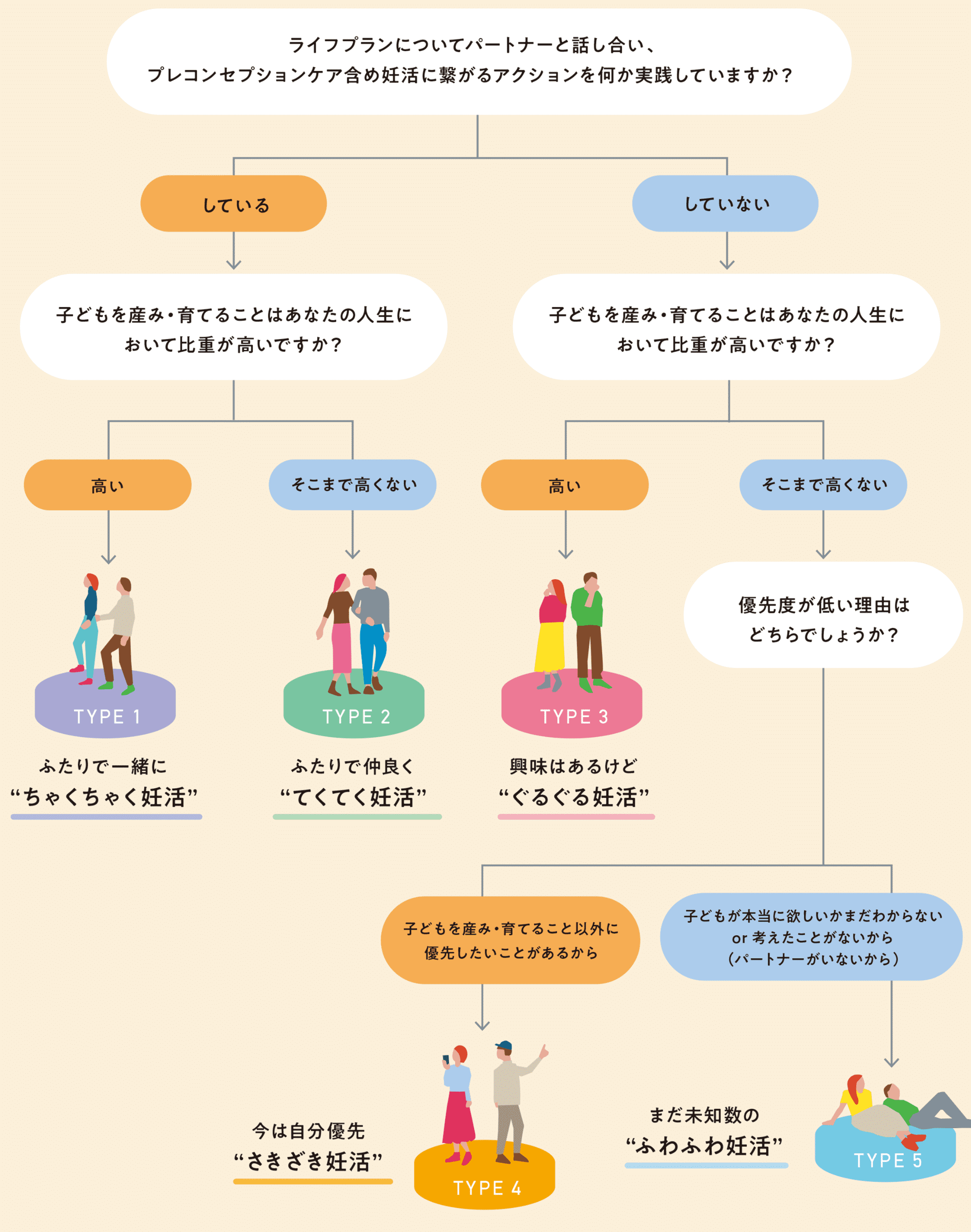
chart

Many people still say they don't want children. However, what we aimed for this time was to gain a more concrete understanding of the diversifying attitudes towards fertility among young people, which we glimpsed from last year's wavering "I don't want children, but I want to keep the possibility of conceiving open" among those preparing for fertility treatment.
Through this year's survey, we gained three specific insights into the diversification and evolution of attitudes towards fertility treatment. First, there is the existence of "men actively seeking to conceive," a phenomenon unique to the Reiwa era. Second, the continued existence and increase of those "preparing for fertility treatment" as in the previous year. Third, there is a group that could be called the "fertility treatment awareness switch group," who feel that they were glad to have had children after going through fertility treatment, even though they didn't initially want them.
In particular, this year's new insights about "men trying to conceive" highlight their main actions, such as "discussing, researching, and being considerate," as they understand that their partner is the one who will actually be physically pregnant and give birth. Their approach to fertility is not about being the main character or a supporting character, but rather about taking proactive steps with consideration for their partner and exploring what kind of family they can create—a truly admirable sight.
What I also realized through these three insights is the coexistence of conflicting emotions and values, such as "I don't want children, but I want to keep the possibility open," "Regardless of gender, let's actively do what we can for each other," and "I didn't want children, but I'm glad I had them." Holding onto these conflicting feelings may be unstable and anxiety-inducing. However, the fact that my own unique present and future are actually emerging from this may provide clues for the future.
Through this survey, Rohto Pharmaceutical has reaffirmed the importance of not only grasping major societal trends, but also focusing on the real lives of each individual living within them, and helping them create their own unique lives. We look forward to continuing to think and move forward together with you.

Trying to conceive