Causes and mechanisms of blackheads (comedones)
Blackheads caused by clogged pores can occur even in the early stages of acne.
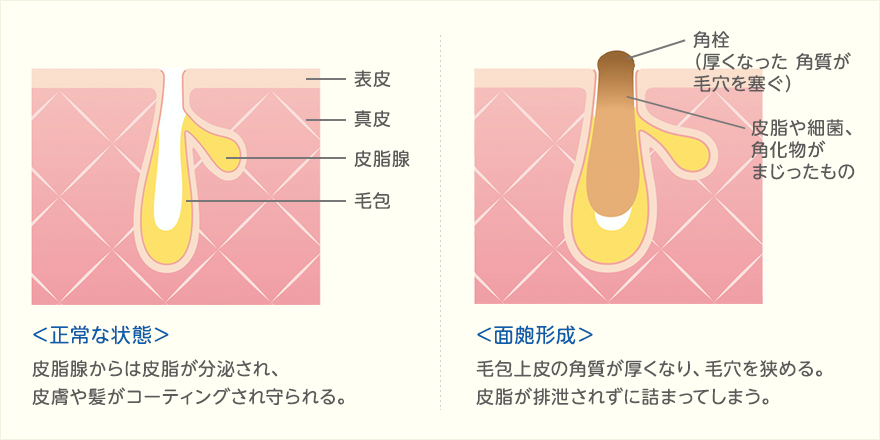
First, the initial stage of acne is the formation of "comedones." Comedones are caused by factors such as increased sebum secretion and keratinization of the skin, which clog the pores, preventing sebum from escaping and causing it to accumulate excessively within the hair follicle, forming a sac-like structure.
Initially, a small, whitish white pimple appears, and the pore becomes closed, resulting in a condition called "closed comedone."
A little later, the sebum that has accumulated inside the pores pushes them open, causing them to become dark in color. This is called an "open comedone."
The dark color is believed to be due to melanin being expelled from within the skin.
The main cause of acne is increased sebum secretion and keratinization of the pores, which are due to increased secretion of male hormones, leading to increased function of the sebaceous glands. In women, acne is more likely to occur when the secretion of estrogen, which suppresses male hormones, decreases due to dieting, irregular lifestyle, or stress, resulting in a relative increase in male hormones in the body.
The female hormone progesterone also increases sebum secretion. Secretion is particularly high during the period from ovulation to menstruation. In addition, stress, excessive tension, fatigue, and insomnia can disrupt the autonomic nervous system, which in turn can lead to increased sebum secretion through hormone release.
Other causes include directly blocking pores with prolonged makeup wear, and making the skin surface prone to oiliness due to incorrect cleansing methods.
Furthermore, it has become clear that the cause is not only an increase in sebum secretion, but also issues with skin cell turnover. When dead skin cells around the pores do not slough off properly, the stratum corneum thickens, blocking the pores.