Vaginal candidiasis (Mentholatum® Freddy® CC)

Vaginal candidiasis is a disease that can affect anyone,
It is still not widely known.
Here, we will explain vaginal candidiasis.

What is Vaginal Candidiasis? (Mentholatum® Freddy® CC) Vaginal candidiasis is a condition that can affect anyone, but it is still not well understood. Here, we will explain what vaginal candidiasis is.

What is vaginal candidiasis?

Itching, severe itching of the vulva, changes in the amount and consistency of vaginal discharge.

Vaginal candidiasis is a type of vaginitis caused by a fungus called Candida.
Candida is a type of fungus that is naturally present in the body, regardless of gender, and can be found on the skin, in the mouth, and in the intestines. The presence of the fungus does not necessarily mean that a disease will develop, but it is a disease that develops when the fungus proliferates due to some trigger.

In women, vaginal candidiasis develops when the balance of bacteria in the vagina is disrupted and Candida fungi proliferate. It often involves inflammation of both the vagina and vulva, and is also called "vulvovaginal candidiasis." It is a relatively common gynecological infection, but it is important to receive appropriate treatment.

What are the symptoms of vaginal candidiasis?

The main symptoms include severe itching, a burning sensation, and redness of the vulva and vagina. There may also be an increase in white discharge resembling sake lees or cottage cheese. Pain may also be experienced during urination or sexual intercourse.
Candida infection is a common infection in women caused by an overgrowth of a type of fungus called Candida in the vagina and vulva. It is said to be more likely to occur before menstruation, after taking antibiotics, or when the body's resistance is weakened due to fatigue or stress.

What causes vaginal candidiasis?

What causes vaginal candidiasis?

Vaginal candidiasis is a disease that develops when the body's resistance is weakened, such as when the balance of bacteria is disrupted, and it is relatively common among gynecological infections in women. Although it is often thought of as a sexually transmitted infection (STI), some reports indicate that infection through sexual intercourse accounts for only a few percent of cases, which is not particularly high.

You might worry, "Is it because I'm not clean enough?" or "Did my partner pass it on to me during sex?" and hesitate to go to the hospital, but if left untreated, it can worsen and become more difficult to cure, so it's important to get appropriate treatment early.

Factors that can trigger vaginal candidiasis include antibiotic use, weakened immunity due to pregnancy or diabetes, and dampness caused by underwear. However, it can also develop even without these triggers.

Recently, it has been suggested that a decrease in the body's resistance due to excessive stress, fatigue, and irregular lifestyle habits may also be contributing factors.

There is a non-zero chance of infecting your partner. If you experience any uncomfortable symptoms such as itching or redness in your genital area, it is crucial to see a doctor immediately.

Treatment methods for vaginal candidiasis

If vaginal candidiasis is suspected, you should see a gynecologist or obstetrician. The examination will involve checking the symptoms of the vagina and vulva, and inserting a speculum to examine the characteristics of the vaginal discharge.

If diagnosed with vaginal candidiasis, treatment involves antifungal vaginal suppositories or other medications. Candida is a type of fungus, similar to the fungus that causes athlete's foot (dermatophyte). Fungi differ from bacteria in their cellular structure, and antifungal medications are used for treatment.

Antifungal agents such as isoconazole nitrate are used to treat Candida fungi. The treatment period is typically one week.

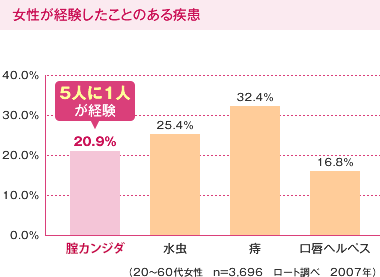
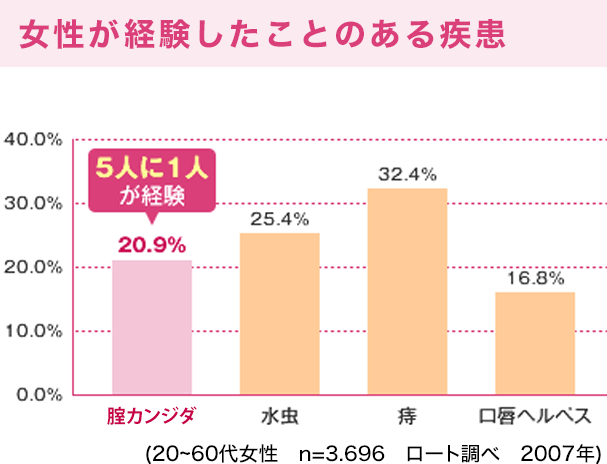
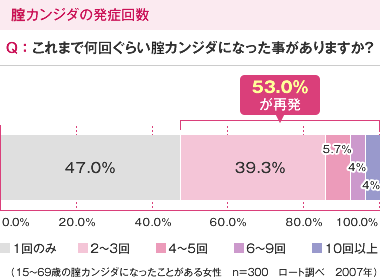
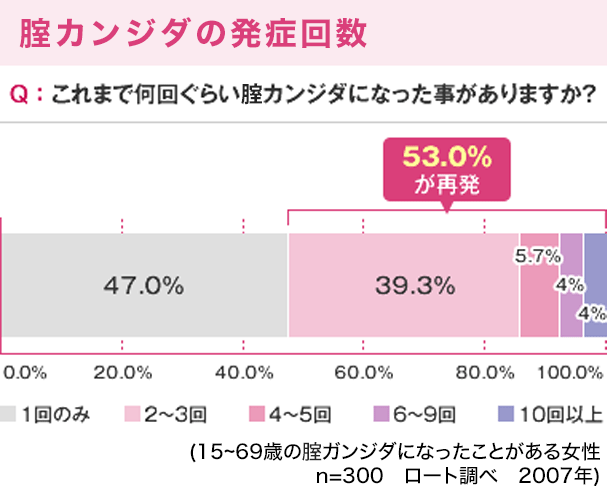
Vaginal candidiasis affects one in five women, and more than half experience recurrence. Above all, it is important to start treatment early and to understand the disease.

Possibility of recurrence

Our research indicates that one in five women aged 20 to 60 have experienced vaginal candidiasis, and more than half of them have experienced it multiple times. Since it is caused by Candida fungus that is naturally present in the body, anyone can potentially develop this condition.

  • Diseases experienced by women: Vaginal candidiasis 20.9% (1 in 5 women experience this) / Athlete's foot 25.4% / Hemorrhoids 32.4% / Cold sores 16.8% / (Women aged 20-60, n=3,696, surveyed by Rohto, 2007)Diseases experienced by women: Vaginal candidiasis 20.9% (1 in 5 women experience this) / Athlete's foot 25.4% / Hemorrhoids 32.4% / Cold sores 16.8% / (Women aged 20-60, n=3,696, surveyed by Rohto, 2007)
  • Number of Vaginal Candidiasis Outbreaks / Q: How many times have you had vaginal candidiasis? / 53.0% experienced recurrence / (Women aged 15-69 who have had vaginal candidiasis, n=300, Rohto survey, 2007)Number of Vaginal Candidiasis Outbreaks / Q: How many times have you had vaginal candidiasis? / 53.0% experienced recurrence / (Women aged 15-69 who have had vaginal candidiasis, n=300, Rohto survey, 2007)

What types of vaginal candidiasis medications are available?

Over-the-counter vaginal candidiasis treatments are broadly divided into two categories: "vaginal suppositories (vaginal tablets)" and "vulvar creams."
Vaginal suppositories are inserted directly into the vagina and work against Candida fungi, which cause itching and discharge.
Vaginal creams are applied to the outer skin of the vagina when itching or redness is a concern. Vaginal suppositories come in different types depending on the duration of use, such as "single-use" and "6-day" types, allowing you to choose the one that suits your lifestyle and the severity of your symptoms. Single-use suppositories involve inserting just one suppository to complete the treatment, while 6-day suppositories involve inserting one suppository daily for a set number of days.

1 tablet (Freddy CC1/CC1A) 6 tablets (standard dosage)
Number of uses 1 time 6th
Period of use Day 1 6th
Applicator Yes Nothing
Suitable for For those who want to complete treatment in one session For those who want to receive treatment every day

Who is the single-tablet type suitable for?

Single-use types like Mentholatum Freddy CC1 and Freddy CC1A are suitable for people who are busy every day and have difficulty finding time to continue taking medication, or for those who want to complete treatment with as little hassle as possible. Since treatment is completed by simply inserting the vaginal suppository once, there is less worry about accidentally forgetting to insert it, which is a major advantage.

  • For those who have unpredictable schedules, such as those raising children or working long hours, and find it difficult to use the service at a fixed time every day.
  • Those who have forgotten to take the medication for six consecutive days during a past relapse.
  • For those who want to reduce the number of times they insert something into their vagina

*The medication is administered only once, and the drug remains in the vagina and takes effect gradually, so please do not use any additional vaginal suppositories.
However, if symptoms do not improve after 3 days or if symptoms do not disappear after 6 days, please consult a doctor.

How do I use vaginal suppositories?

When to use
It is recommended to use it before going to bed at night, if possible.
How to use
It is recommended to relax your body and insert with one knee bent.
For detailed instructions on how to use it, please refer to the link below.

How to use vaginal suppositories

Who is ineligible to use over-the-counter vaginal candidiasis medications?

The following are some of the most common individuals who cannot use medication for treating relapses:

  • People who have never been diagnosed with or treated for vaginal candidiasis by a doctor before.
  • Individuals experiencing repeated recurrences of vaginal candidiasis in a short period of time (once within two months or twice or more within six months)
  • People who are unsure whether they have a recurrence of vaginal candidiasis

For more information, please consult your doctor or pharmacist.

To prevent the disease from developing

Candida is a type of fungus that is naturally present in the body, but the presence of the fungus in the vagina does not necessarily mean that a disease will develop. A disease develops when Candida proliferates due to some trigger. In daily life, it is a good idea to keep the following points in mind.

Precautions for daily life

  • Candida fungi thrive in humid and warm conditions, so try to keep the area as dry as possible.
    • After bathing or swimming, thoroughly dry the outside of the vagina and change out of wet swimwear as soon as possible.
    • When using sanitary products such as panty liners, change them frequently.
    • Wear breathable underwear.
  • When bathing, to avoid irritation from soap, only lightly wash the vulva with warm water.
  • Use clean underwear and towels every day.
  • To avoid infection, do not share towels or other items with family members.
  • Candida fungi are also present in the intestines. To avoid infection, wipe from front to back after using the toilet.
  • Even if you experience itching, avoid scratching your genital area. This could worsen the condition or spread the infection.

Purchase from Rohto Pharmaceutical's official online store.

Purchase from Rohto Pharmaceutical's official online store.