From the meeting of sperm and egg to implantation

Next, please explain how the sperm, once ejaculated, get to the egg!
Mr. Masayuki Kinutani
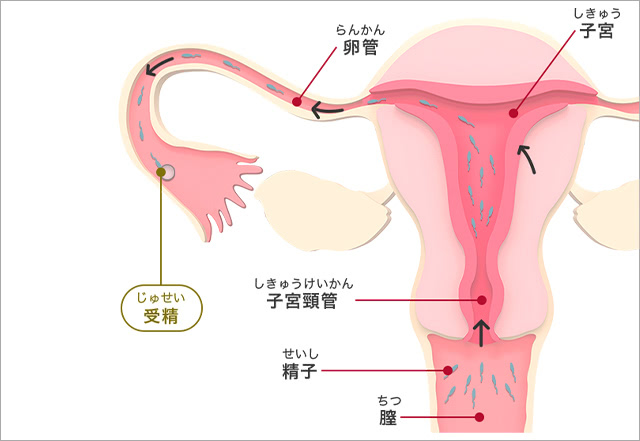
First, ejaculated semen does not enter the uterus. Then, only sperm swim up the cervix, which is about 3-4 cm long and connects the vagina to the uterus, and enter the uterus.
At this time, the cervical mucus secreted from the wall of the cervix plays a very important role. Normally, cervical mucus protects the uterus from bacteria and other pathogens, but as ovulation approaches, the amount of mucus secreted increases, and it becomes clear, watery, and stretchy, which helps sperm enter the uterus.
The sperm that enter the uterus then travel through the fallopian tubes, reaching the ampulla of the fallopian tube where the ovulated egg is transported, and wait there until the egg arrives.
So the semen doesn't enter the uterus directly, right...?
If tiny sperm have to swim on their own, it seems like it would take quite a long time.
Mr. Masayuki Kinutani
Since the distance from the opening of the uterus to the ampulla of the fallopian tube is about 18 cm, it would take a considerable amount of time for sperm to swim that distance on their own.
However, it is thought that the uterus actually contracts, acting as a pump to help sperm travel to the fallopian tubes, and that sperm can reach the ampulla of the fallopian tube within a few minutes to a few hours after ejaculation.
I was surprised it was faster than I expected!
The egg and sperm finally meet after going through this process.
Mr. Masayuki Kinutani
When sperm and egg meet in the ampulla of the fallopian tube, the sperm penetrates the egg's outer layer headfirst, and the sperm and egg become one. This is called fertilization.
The fertilized egg grows in the fallopian tube through repeated cell division, and implants in the uterine lining 5 to 7 days after fertilization, leading to pregnancy.