Glaucoma Support Navi

Who is prone to developing glaucoma?

Some people are more prone to developing glaucoma.
It is said that some people are less likely to develop this condition.
Even those who have not yet developed glaucoma, Future Let's check your risk of developing the disease together.

If you understand the risks, you can take countermeasures.

Glaucoma
Those at risk of developing the disease

  • Glaucoma is known to have an increased risk of developing with age. A large-scale study conducted by the Japanese Glaucoma Society (the Tajimi Study) found that approximately 5% of people aged 40 and over had glaucoma.
    People who develop glaucoma and experience difficulties in their daily lives by the age of 60 often begin to experience symptoms around the age of 40, but it is said that in most cases the symptoms at the time of onset are mild and go unnoticed.
    Even if you don't have any problems with your field of vision, once you turn 40, we recommend that you have regular eye examinations at a hospital, including glaucoma screenings.

  • It is said that high intraocular pressure increases the risk of developing glaucoma. This is because elevated intraocular pressure can damage the optic nerve, potentially leading to the development of glaucoma.
    The upper limit for normal intraocular pressure is said to be 20 mmHg, and anything higher than this is a warning sign. You should have your intraocular pressure checked regularly at the hospital.

    On the other hand, having low intraocular pressure doesn't mean you can rest easy. Some people develop glaucoma even with normal intraocular pressure. This is called normal-tension glaucoma, and it's a common type of glaucoma among Japanese people.

  • People with poor blood circulation, who tend to get cold easily, and those with low blood pressure are also said to be more prone to developing glaucoma.

    In recent years, the relationship between glaucoma patients and ocular blood flow has become clearer.

    Our bodies primarily use blood to deliver oxygen and nutrients throughout the body and to flush out waste products.
    People with high blood pressure have poor blood flow because their blood vessels constrict, but people with low blood pressure also have difficulty delivering blood to all parts of their body because their pumping power is weak. In particular, the eyes and brain, which are above the heart, do not receive enough oxygen and nutrients.
    As a result, the optic nerve can be affected, increasing the likelihood of developing glaucoma.

  • It is said that people with severe nearsightedness are more prone to developing glaucoma.
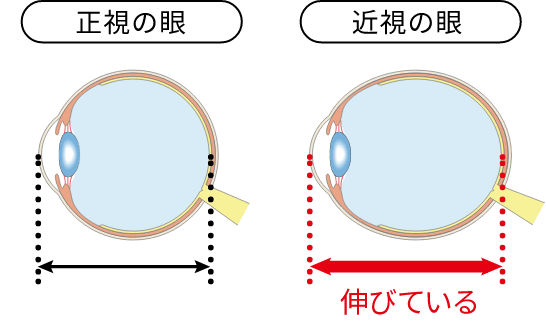
    In recent years, myopia has been increasing in Asian countries, including Japan, due to changes in living environments. Compared to people with normal vision, those with severe myopia have eyes that are significantly elongated in the anterior-posterior direction. When the eye is elongated, nerves and blood vessels can be stretched. As a result, it is said that the risk of developing glaucoma increases.

    People with severe nearsightedness are at a higher risk of developing eye diseases such as glaucoma and retinal detachment, so it is important to have regular eye examinations.

  • Glaucoma is said to be related to genetics, and it has been shown that having blood relatives such as parents or grandparents with glaucoma increases the likelihood of developing the disease.

In addition to the above, diabetes, migraines, and sleep apnea are also known risk factors for glaucoma. The more of these factors you have, the more likely you are to develop glaucoma.

If any of the above points apply to you, we recommend that you get your eyes checked at a hospital, even if you don't feel any abnormalities.

glaucoma
For early detection
Please see an ophthalmologist.

To detect glaucoma,
I went to see an ophthalmologist.
Fundus examination * etc.
You need to.
Without fundus examination
A health checkup alone is insufficient.
If you have any concerns about your eyes,
Consult an ophthalmologist.

*Using a camera, etc., the blood vessels at the back of the eye,
Examination to check the retina, optic nerve, etc.

Supervision
Tohoku University
Chief Professor, Department of Ophthalmology, School of Medicine
Toru Nakazawa teacher
Information site for healthcare professionals - Rohto Professional Site Consortium for the Early Detection of Eye Diseases