Are your rough heels just athlete's foot, not dryness?

[Column] Are those rough, cracked heels actually caused by "heel athlete's foot" rather than just dryness?!

Is treating athlete's foot the shortcut to smooth heels?

If you have dry, cracked heels with peeling skin that won't go away (even if the itching is mild), have athlete's foot on your toes or get it repeatedly, or have a family history of athlete's foot, then you should consider the possibility of heel athlete's foot.

*Heel athlete's foot refers to athlete's foot that develops on the heels.
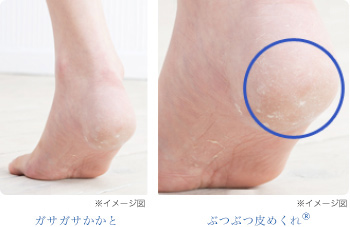
Photos of rough, cracked heels and bumpy, peeling skin®

If athlete's foot that develops between the toes is left untreated, the fungus can penetrate deep into the stratum corneum, eventually spreading to the entire sole of the foot, especially the heel (it does not occur only on the heel). Visually, it is difficult to distinguish from cracks or chapped skin, and the entire sole of the foot becomes powdery. It is one of the more difficult types of athlete's foot to treat, and if left untreated, it can develop into onychomycosis (nail fungus), which is even more difficult to treat, so caution is necessary.

When treating athlete's foot on the heels at a hospital, the method used involves softening the calluses with urea before applying the antifungal medication.
To heal it quickly, it's important to wash the affected area thoroughly with soap and keep it clean, wipe off sweat with a towel and dry it completely, apply the medication broadly to the affected area, especially after a bath when the skin is soft, and continue treatment for a while even after the symptoms seem to have subsided. Athlete's foot is a treatable disease, so treat it properly and aim for clean, smooth, and beautiful heels!

Check now! Do I have athlete's foot?

Athlete's foot is a disease caused by a type of fungus called "dermatophyte," which infects the outermost layer of the skin, the stratum corneum. The name of the disease varies depending on the part of the body that is infected, and when it occurs on the hands and feet, it is called "athlete's foot." It is also divided into three types based on the symptoms.

Symptoms
  • Between the toes

    Interdigital type photograph

    This is the most common type of athlete's foot. It can be divided into two types: the wet type, where the skin between the toes becomes moist, soggy, and oozing, and the dry type, where the skin peels thinly and becomes red. The wet type is often very red, and in some cases, secondary bacterial infections can cause the entire foot to swell.

  • Soles of the feet, edges, and base of the toes

    vesicle type photograph

    Small blisters containing a clear, slightly sticky fluid appear on the soles, edges, and bases of the toes. When they burst, the fluid is released, and the area gradually dries up and the skin peels. The area is often red and itchy, but it doesn't always itch, and the blisters may not be very noticeable, so they can go unnoticed and be left untreated.

  • heel

    Photograph of hyperkeratotic type

    It's all over the soles of my feet, specifically on the hard parts of my heels. It's flaky, but there's hardly any itchiness.

We take care to post accurate information,
Please point out any incorrect information.

Please submit any comments regarding medical information here.

Related Products

Related Articles